
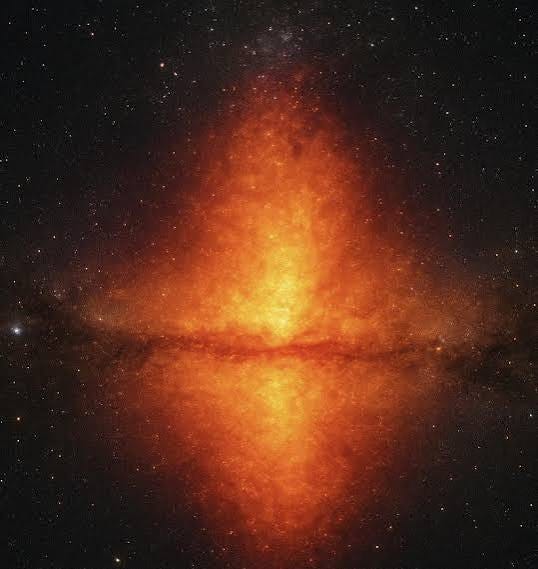
Dark matter and modified gravity are competing theories, and the evidence favors one
That is the framing on both sides. Two rivals, one growing pile of observations, a winner emerging.
They are not competing on most of the evidence, because most of the evidence cannot separate them
Dark matter accounts for observations across many scales: early universe structures, gravitational lensing, galactic rotation curves. Rotation curves are also well explained by modified gravity. That overlap is the whole problem.
The two accounts are structurally different. Dark matter explains rotation curves with a large halo of new, uncharged matter — uncharged, so it never radiated away energy and never collapsed further. MOND explains them with new fields extending Einstein’s general relativity, modifying Newton’s law at large distances.


Different objects, different mathematics, same curve. Modified gravity is hard to test independently of dark matter, which is exactly how two ideas about different things get filed as rivals. A test that both pass is not a test.
One system type separates them, and the reason is density
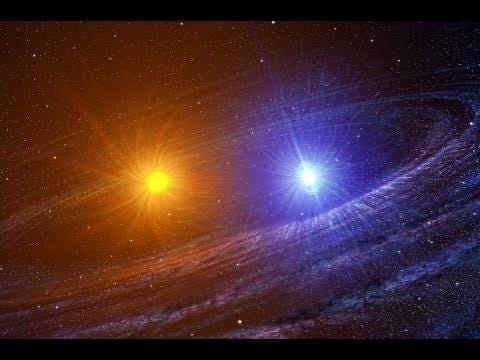
Hernandez, Jimenez and Allen proposed the clean case (arXiv:1105.1873): wide binary stars. Two stars orbiting each other at a radius several thousand times the Earth–Sun distance.
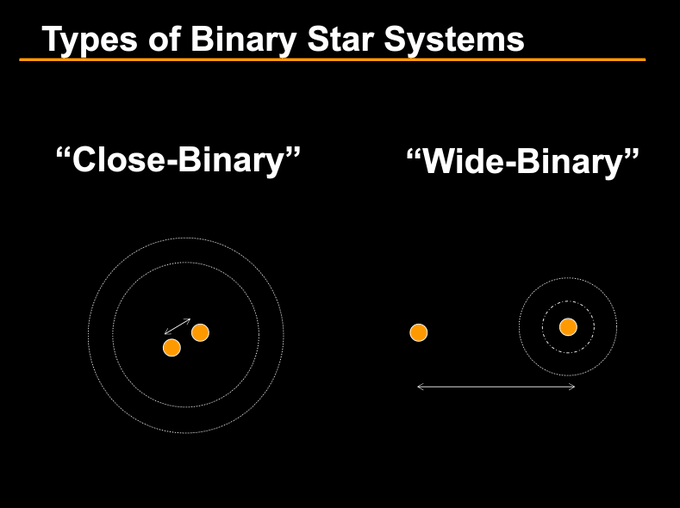
The logic is a fork with no shared branch. If dark matter exists, it does not affect these orbits — the halo is not dense enough at that scale to matter. If gravity is modified at large distances, the orbits show it, because the separation puts them in the regime where the modification is supposed to bite.
Either the deviation is there or it is not. Dark matter has no way to produce one, and no way to explain one away.
The data exists, and the deviation is there
ESA’s Gaia has observed about 100,000 very wide binary systems. Recent studies of them find a discrepancy — the kind that would indicate physics beyond general relativity.
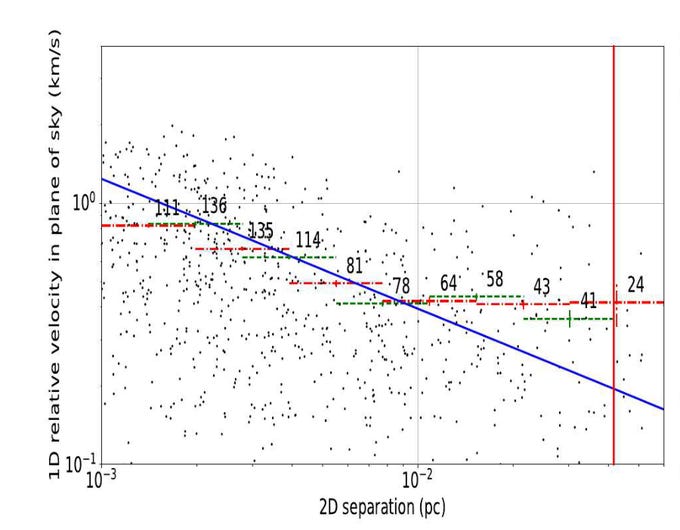
The shape of it is where the story stops being clean. Plotted as separation against relative velocity, the systems follow Newton’s law at smaller separations and depart from it at large ones. The departure is not what MOND predicts either. The threshold where modified-gravity effects are expected to appear sits elsewhere on the plot than where the data turns.
A result that breaks one theory and does not confirm the other is the least quotable outcome available, and it is the one on hand.
The measurement is hard, and the uncertainties are not resolved
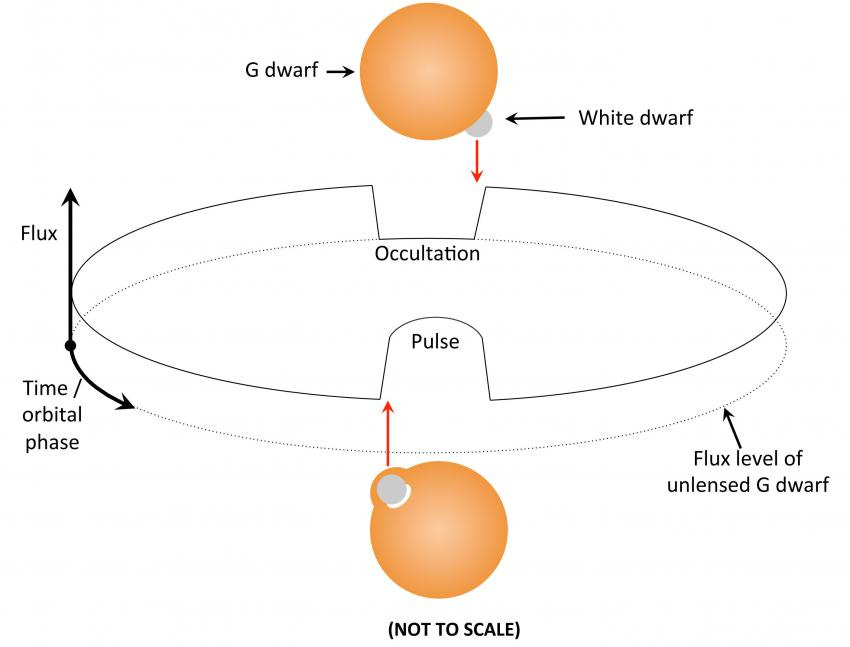
These measurements have to account for many sources of uncertainty: the orientation of the orbital plane, other objects perturbing the orbit, redshifts, and more. Whether the observed deviation is a sign of new physics is not established. More data and longer observation are required to reduce the uncertainties, and that work is not finished.
The strongest case against all of this
A dark matter cosmologist would say the wide-binary test is being oversold as decisive. Systematics dominate at these separations — contamination from undetected third companions alone can manufacture exactly this signal, and the analyses are difficult in ways that do not apply to lensing or the cosmic microwave background. Meanwhile dark matter’s successes span scales this test never reaches, and no wide-binary result touches early-universe structure formation. Concede all of it. The correction holds anyway, because the objection is about whether this measurement is clean enough yet, not about whether the test is valid in principle — and in contrast to virtually all other tests, this one is independent of the presence of dark matter. That property does not go away because the error bars are still large.
Three things to check before you repeat a dark matter versus MOND claim
Ask whether the observation discriminates. Rotation curves, lensing, early structure — most evidence is explained by both. Evidence compatible with two theories favors neither.
Check the density scale. The wide-binary test works because a dark matter halo is too diffuse to influence orbits at that separation. Any test at a scale where the halo does contribute cannot separate the two.
Separate the deviation from the confirmation. Gaia’s wide binaries show a departure from Newtonian expectation. They do not show MOND’s predicted threshold. Those are two different findings.
Those checks tell you how to read the dispute. They do not tell you which specific quantities are measured, which are proposed, and what the deviation actually looks like against each prediction.
The claim, reissued: what the wide-binary test constrains
Settled — the sample. About 100,000 very wide binary systems observed by ESA’s Gaia. Wide meaning orbital radii several thousand times the Earth–Sun distance.
Settled — the test’s independence. Wide binaries are, in contrast to virtually all other tests, independent of the presence of dark matter. A halo is not dense enough at these separations to affect the orbits. This is the property that makes the test worth running.
Settled — the theoretical fork. Hernandez, Jimenez and Allen, arXiv:1105.1873 — a preprint archive posting, cited as the proposal for the method. Dark matter predicts no orbital effect. Modified gravity predicts one.
Settled — the Newtonian regime. Smaller systems follow Newton’s law. Separation against relative velocity tracks the predicted line.
Not constrained — the systematics. Orbital plane orientation, perturbing objects, redshifts, and other sources of uncertainty are acknowledged and not eliminated. The deviation’s significance rests on their treatment.
Not constrained — whether the deviation is new physics. Recent studies find a discrepancy consistent with physics beyond general relativity. Consistent with is the operative phrase. More data and longer observation are required.
Pending — the MOND match. The deviation appears at large separations. The threshold where modified-gravity effects are expected sits at a different point on the plot. The data does not currently land on the MOND prediction.
Pending — everything above galactic scale. This test says nothing about lensing, cosmological structure, or the matter ratio in the early universe. It separates two theories in one regime only.